10 JavaScript ES2026 Features Developers Should Know
On June 30, 2026, Ecma International approved ECMAScript 2026 (ES2026) the 17th edition of the ECMA-262 specification. Unlike previous years, this release cycle has been surrounded by unusual confusion: several widely-shared "ES2026 features" lists online incorrectly include Temporal and Explicit Resource Management (using), features that actually missed the ES2026 cutoff and are slated for ES2027 instead.
This article clears that up by covering the New features every developer must know in modern JavaScript. Below are the 7 features officially confirmed for ES2026 by TC39's finished-proposals list, plus 3 major Stage-4 features arriving in ES2027 that are worth knowing about now, since they're already usable in modern browsers and Node.js. Each feature includes the problem it solves, a code example, and what it replaces so you can understand what's actually shipping today and what’s coming next.
What's Actually Confirmed in ES2026 (7 Features)
1. Array.fromAsync
Converting an async iterable into an array previously meant manually looping and pushing values one at a time. Now it's a single line:
const results = await Array.fromAsync(asyncGenerator());
Takeaway: Cleaner async data collection, no manual accumulator needed.
2. Error.isError
Checking whether something is "really" an Error object has long been unreliable across realms (iframes, workers, VM contexts), since instanceof Error can fail there. Error.isError() gives a dependable, cross-realm check:
Error.isError(new TypeError("oops")); // true
Takeaway: One reliable check replaces fragile instanceof workarounds.
3. Math.sumPrecise
Summing floating-point numbers with reduce can silently produce incorrect results due to precision loss:
[1e17, 1, -1e17].reduce((a, b) => a + b); // 0 — wrong
Math.sumPrecise([1e17, 1, -1e17]);        // 1 — correct
Takeaway: Critical for financial calculations, analytics, and any precision-sensitive math.
4. Uint8Array Base64/Hex Methods
Encoding binary data used to require an external library. Now it's built in:
const bytes = new Uint8Array([72, 101, 108, 108, 111]);
bytes.toBase64(); // "SGVsbG8="
bytes.toHex();    // "48656c6c6f"

Uint8Array.fromBase64("SGVsbG8=");
Uint8Array.fromHex("48656c6c6f");
Takeaway: One less dependency in most projects handling binary data.
5. Iterator.concat
Chain multiple iterators together without first converting each to an array:
for (const item of Iterator.concat(iter1, iter2, iter3)) {
  console.log(item);
}
Takeaway: Simpler, more memory-efficient iterator composition.
6. JSON Source Text Access + JSON.rawJSON()
JSON.parse's reviver function now receives a third argument exposing the raw source text, and JSON.rawJSON() lets unprocessed JSON be injected directly into JSON.stringify() output. Together, these finally let BigInt values round-trip cleanly through JSON — previously only possible with lossy string workarounds.
Takeaway: Solves a long-standing BigInt-and-JSON pain point natively.
7. Map/WeakMap.prototype.getOrInsert
The "check if a key exists, else insert a default" pattern is now a single call:
const cache = new Map();
const value = cache.getOrInsert(key, computeExpensiveDefault());
It only inserts the default when the key is genuinely absent — no more has() + get() + set() boilerplate.
Takeaway: Cleaner caching and memoization logic.
3 Big Features Coming Next in ES2027
These four proposals reached Stage 4 TC39's final approval stage just after the ES2026 cutoff, which means they technically belong to next year's spec. They're included here because they're significant enough that skipping them would leave a real gap, and they're already usable in modern browsers and Node.js today. Developers following a Node.js Complete Beginner's Guide can also benefit from understanding these upcoming JavaScript features, as they will become part of the modern Node.js ecosystem over time.
8. Temporal
The long-awaited replacement for Date. Immutable, timezone-aware, and free of the zero-indexed-month bugs that have caused countless off-by-one errors for three decades:
const now = Temporal.Now.plainDateISO();
const meeting = Temporal.PlainDateTime.from("2026-11-05T14:00");
Takeaway: The single most-requested fix in JavaScript's history is finally arriving.
9. Explicit Resource Management (using / await using)
Automatic cleanup when a variable goes out of scope — similar to try/finally, but built directly into the language syntax:
{
  using file = openFile("data.txt");
} // file is automatically closed here
Takeaway: Less manual cleanup code, fewer resource leaks.
10. Atomics.pause
A low-level addition for concurrent programming: a hint to the CPU that a thread is spin-waiting, which improves performance in tight polling loops within SharedArrayBuffer-based code.
Takeaway: A niche but meaningful win for developers working with shared-memory concurrency.
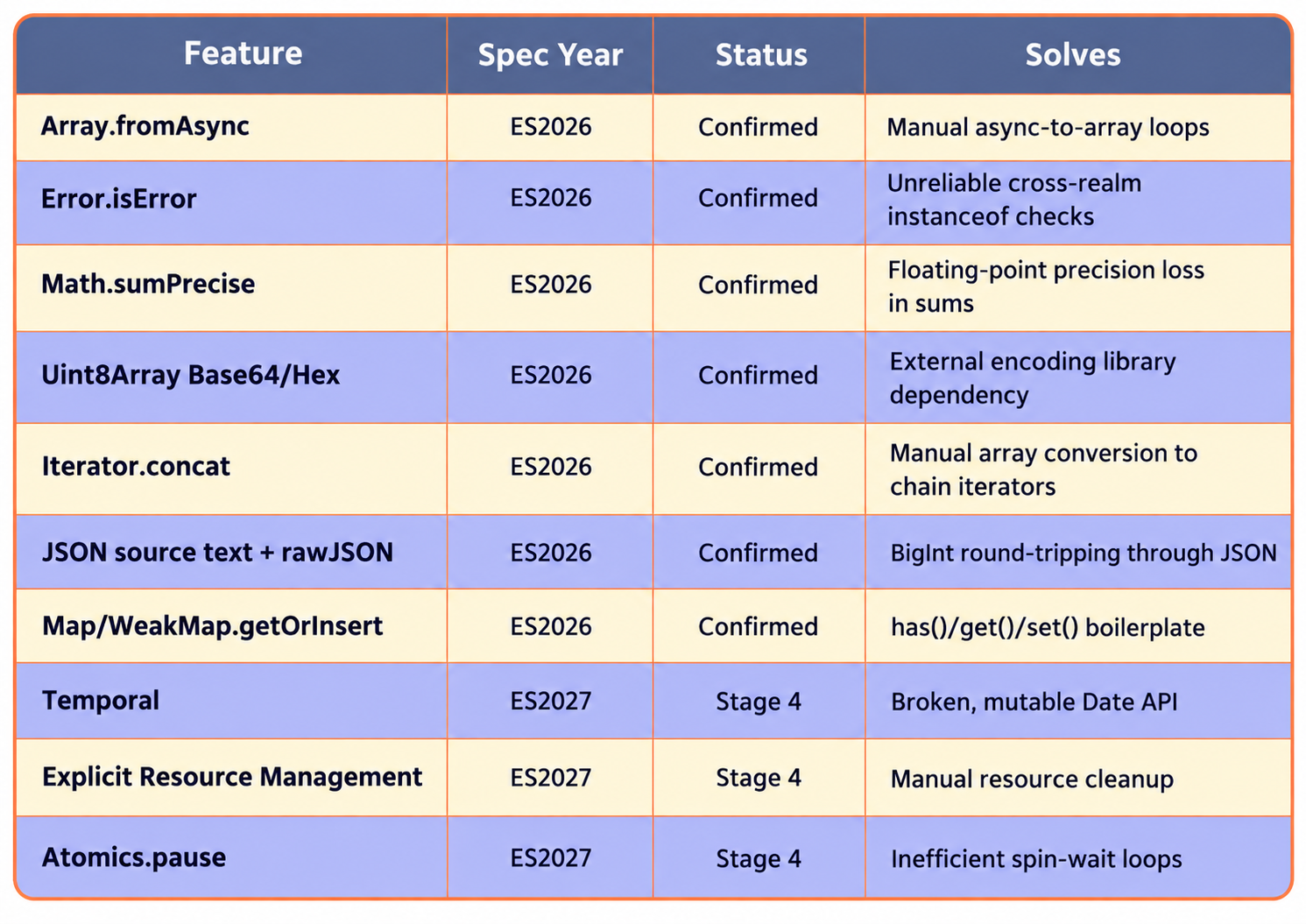
ES2026 vs ES2027 — Quick Comparison Table
Browser & Node.js Compatibility Snapshot
Being part of the official ES2026 spec doesn't automatically mean a feature is safe to use everywhere today. Per MDN's Baseline tracking:
Array.fromAsync Baseline 2024 (widely available across all major browsers and Node.js/Deno for over a year already)
Uint8Array.fromBase64() / toBase64() Baseline 2025 (broadly supported in current browser versions)
Math.sumPrecise() Baseline 2026 (the newest addition; check your target runtime before relying on it in production)
For frontend teams: always check Baseline status per feature rather than assuming "it's in the spec, so it's safe." A feature can be finalized in ES2026 and still be missing from older but still-common browser versions.
For backend/CLI teams (Node.js, Deno, Bun): pin your runtime version deliberately. Features close to I/O binary/token handling, file-chunk conversion, JSON serialization will fail fast in production if the runtime doesn't support them yet, so version-lock rather than assume.
Rule of thumb: if a feature is in the ES2026 spec but not yet Baseline-stable in your target environments, use it behind a feature check or polyfill until adoption catches up.
Conclusion
ES2026 isn't a flashy release, but it's a genuinely useful one: precision math, native binary encoding, cleaner async iteration, and less boilerplate around common patterns like caching and JSON handling. And with Temporal, using, and Atomics.pause already at Stage 4 for ES2027, the rough edges JavaScript has carried for decades are finally getting sanded down. As developers adopt these improvements, proper testing becomes even more important, and resources like a Jest Testing Guide can help ensure new JavaScript features are integrated reliably without introducing unexpected behavior.
Keeping a codebase current with spec changes like these isn't always a priority when deadlines are tight but outdated patterns quietly add up to slower, harder-to-maintain code. If your team needs help modernizing a legacy JavaScript/Node.js codebase or building new features on the latest standards, Synfinity Dynamics works with teams on exactly this kind of upgrade.
What's your favorite feature from this list confirmed or upcoming? Drop a comment below.