Is Cloud Really Cheaper Than On-Premise?
Over the past decade, cloud adoption has exploded. Companies of every size have moved away from racks of physical servers and into AWS, Microsoft Azure, and Google Cloud. Along the way, a belief has taken hold as conventional wisdom: cloud is cheaper because you don't have to buy hardware.
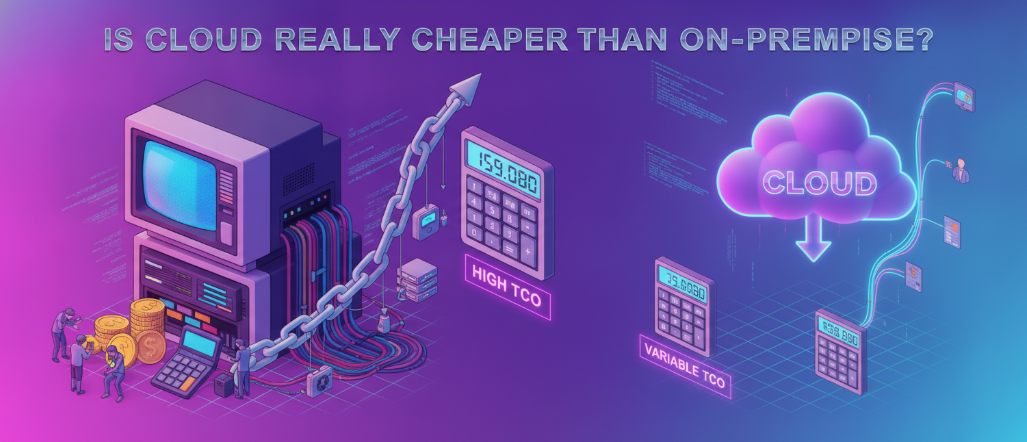
But the real answer is more nuanced. Whether cloud actually saves you money depends on your usage patterns, team size, workload type, and infrastructure requirements. To answer the question properly, you need to look past the monthly bill and calculate the Total Cost of Ownership (TCO) the full cost of running your infrastructure over its entire lifecycle, not just what shows up on an invoice.
What Is Cloud Computing?
Cloud computing means your infrastructure is hosted and maintained by a third-party provider think AWS, Microsoft Azure, or Google Cloud and you pay for what you use, when you use it. Instead of owning servers, you rent compute, storage, and networking capacity on demand.
The appeal is obvious: fast scaling, no hardware management, global availability, and a wide range of managed services that handle everything from databases to Kubernetes clusters.
What Is On-Premise Infrastructure?
On-premise infrastructure means the company owns and operates its own physical servers, typically housed in a private data center. This gives businesses full control over their hardware, predictable capacity, the ability to build custom configurations, and complete ownership of their data.
Why People Think Cloud Is Cheaper
The perception that cloud is automatically the cheaper option comes from a few genuine advantages:
No large upfront hardware purchase
No in-house server maintenance
A pay-only-for-what-you-use billing model
Faster deployment timelines
Smaller infrastructure teams needed
All of that is true but it only tells half the story. Lower upfront cost does not always mean lower long-term cost. Cloud bills can quietly grow into a much larger expense than an equivalent on-premise setup, especially at scale.
Cloud Cost Breakdown
To understand where cloud spending actually goes, it helps to break it into categories:
Compute Costs - virtual machines, containers, and serverless functions all carry their own pricing models.
Storage Costs - database storage, object storage, and backup storage each add up separately.
Network Costs - data transfer, API traffic, and CDN usage are often the most underestimated line items on a cloud bill.
Managed Services - managed databases, Kubernetes services, and monitoring tools add convenience, but also cost a premium over self-managed alternatives.
Operational Costs - DevOps engineers, cloud management overhead, and security monitoring are still required even when the provider "manages" the infrastructure.
On-Premise Cost Breakdown
On-premise infrastructure has its own set of costs, many of which are easy to overlook:
Hardware Investment - servers, networking equipment, and storage devices all require significant capital upfront.
Maintenance - hardware replacement, repairs, and upgrades are an ongoing expense.
Data Center Costs - electricity, cooling, and physical space aren't free, and they scale with your infrastructure footprint.
Human Resources - system administrators, network engineers, and security teams need to be hired and retained.
Disaster Recovery - backup systems and secondary infrastructure add further cost on top of the primary setup.
Cloud vs On-Premise: Cost Comparison
| Factor | Cloud | On-Premise |
|---|---|---|
| Initial Cost | Low | High |
| Hardware Ownership | Provider owns | Business owns |
| Scaling | Easy | Requires hardware planning |
| Maintenance | Provider handles | Business handles |
| Long-Term Cost | Depends on usage | More predictable |
| Flexibility | High | Limited |
| Control | Lower | Higher |
When Cloud Is Actually Cheaper
Cloud tends to win in a few clear situations:
Startups benefit from avoiding hardware investment altogether, building an MVP faster, and scaling flexibly as they grow.
Growing businesses with variable workloads, global customers, and rapid expansion plans can adjust capacity on demand instead of over-provisioning hardware years in advance.
Development teams that need temporary environments, testing infrastructure, or CI/CD pipelines gain a lot from being able to spin resources up and tear them down instantly.
For example, a startup with unpredictable traffic will almost always spend less on cloud than it would buying servers that sit idle most of the time.
When On-Premise Can Be Cheaper
On-premise infrastructure holds its own in different circumstances:
Stable, large workloads - a company running the same workload 24/7 for years can often save money by owning its infrastructure outright rather than paying ongoing cloud rates.
Strict compliance requirements - some industries require tight data control and custom security policies that are easier to enforce on owned hardware.
Existing infrastructure - companies that have already invested in hardware may not see enough benefit from migrating right away to justify the cost and disruption.
Common Cloud Cost Mistakes
Cost overruns in the cloud are rarely about the pricing model itself they're usually the result of avoidable mistakes:
Leaving unused resources running, such as idle servers, unused databases, and old snapshots
Poor architecture decisions, like using expensive managed services when a simpler solution would work just as well
Lack of monitoring, which lets usage, billing, and performance issues go unnoticed until the bill arrives
Over-provisioning, or creating resources larger than what's actually required
How to Optimize Cloud Costs
A few practices consistently keep cloud spending under control:
Use auto-scaling instead of fixed capacity
Monitor resource usage continuously
Remove unused resources regularly
Use reserved instances where workloads are predictable
Optimize database queries
Implement caching wherever possible
Use dedicated cost monitoring tools
Choose the right service for the job, not just the most convenient one
Hybrid Cloud: A Middle Approach
Many companies don't choose exclusively between cloud and on-premise they combine both. A hybrid approach might mean keeping sensitive data on-premise, running applications in the cloud, and using cloud storage for backups.
On-Premise
     +
Cloud Services
     =
Hybrid Infrastructure
This blend allows businesses to balance cost, maintain control over sensitive systems, and still benefit from cloud scalability where it matters most.
The Future of Infrastructure Costs
Looking ahead, infrastructure decisions are shifting away from a binary "cloud or on-premise" choice and toward efficiency. Cloud cost optimization is becoming a discipline of its own, AI-driven infrastructure management is helping teams catch waste automatically, and serverless and edge computing are reshaping how workloads get distributed. Hybrid architectures are likely to become the default rather than the exception, as businesses look to combine the strengths of both models.
Conclusion
Cloud is not automatically cheaper, and on-premise is not automatically expensive. The right choice depends on your workload, business size, and operational requirements not on which option sounds more modern.
Before making an infrastructure decision, calculate the full Total Cost of Ownership, not just the monthly bill.
The cheapest infrastructure is not always the one with the lowest monthly bill. It is the one that delivers the required performance, reliability, and flexibility at the lowest total cost.
📚 Related Reading
FAQs
Is cloud cheaper than on-premise? It depends on workload stability, scale, and usage patterns. Cloud tends to be cheaper for variable or growing workloads; on-premise can be cheaper for stable, long-term, high-utilization workloads.
What are the hidden costs of cloud computing? Data transfer fees, managed service premiums, idle resources, and the operational overhead of DevOps and cloud management are the most commonly overlooked costs.
When should a company choose on-premise servers? When workloads are stable and predictable, when compliance requires strict data control, or when the company already owns capable hardware.
Is AWS cheaper than owning servers? Not always it depends on utilization. Idle owned servers waste money, but so does an oversized, poorly monitored cloud environment.
What is Total Cost of Ownership (TCO)? TCO is the complete cost of infrastructure over its lifetime, including hardware, maintenance, staffing, electricity, and opportunity costs not just the sticker price or monthly invoice.
Is hybrid cloud better than full cloud? For many businesses, yes hybrid setups let you keep sensitive workloads under direct control while still benefiting from cloud scalability where it adds the most value.