How Does Agentic AI Work? The Agent Loop Explained for Developers
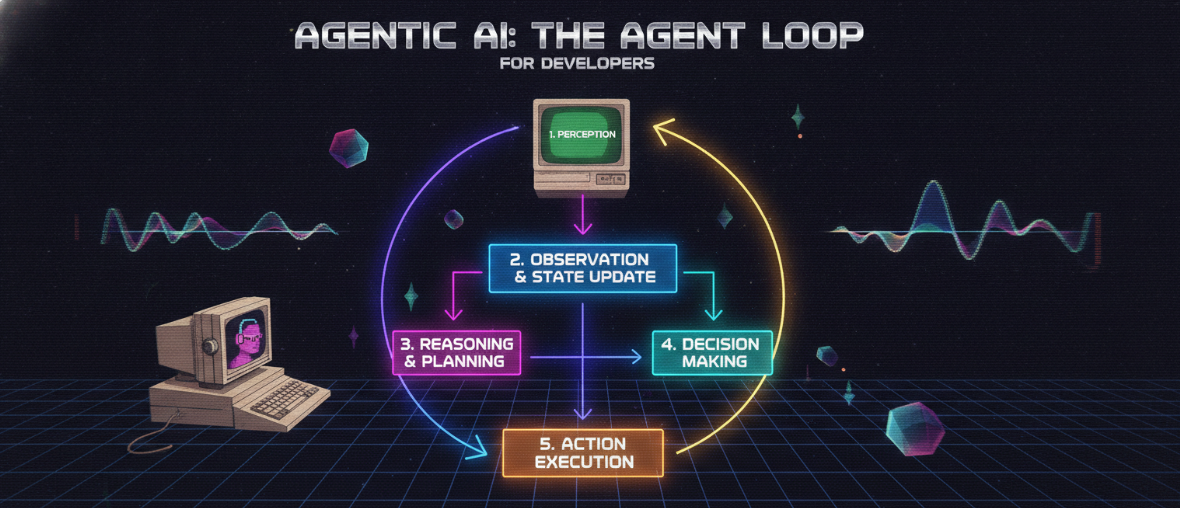
Most AI tools answer once and stop. Agentic AI keeps going until the job is done.
How does agentic AI work? Agentic AI works by running a large language model (LLM) in a loop: it receives a goal, plans the next step, uses a tool to act, observes the result, and repeats until the task is complete. This loop is what lets AI agents handle multi-step work without constant human prompting.
In this guide, we'll break down AI Agents, the agent loop, its core parts, and a real example.
What Makes AI "Agentic"?
AI becomes agentic when it can pursue a goal on its own, deciding what to do next and taking actions instead of only generating text.
A chatbot answers your prompt and waits. An AI agent takes the same goal, breaks it into steps, calls tools like APIs or code runners, checks the results, and adjusts its plan. Think of a chatbot as a knowledgeable advisor, and an agent as an assistant who actually does the work.
The Agentic AI Agent Loop
The agent loop is the core of how agentic AI works. It's a repeating cycle that continues until the goal is met:
Goal: The user or system gives the agent a task, such as "fix this failing test."
Plan: The LLM decides the next best step.
Act: The agent calls a tool, such as a search, API, or code runner.
Observe: It reads the tool's result and updates its understanding.
Repeat: It loops back to planning until the task is done or a limit is reached.
Here is the loop in simple pseudocode:
while not goal_done and steps < max_steps:
    step = llm.plan(goal, memory)
    result = tools.run(step)
    memory.add(step, result)
This pattern is often called the ReAct pattern, short for reasoning and acting. The loop is what separates an agent from a single LLM call.
Core Parts of Agentic AI Architecture
Agentic AI architecture has four main building blocks. Together, they explain how AI agents work behind the scenes.
LLM (the brain): Reads the goal and context, then reasons about what to do next.
Tool calling: Tool calling in AI agents lets the LLM trigger external functions, such as a database query, web search, or API request. The model returns structured output, usually JSON, and your code executes it.
Memory: Short-term memory holds the current task's steps and results. Long-term memory, often a vector database, stores facts and past experiences for later use.
Planning: The agent splits a big goal into smaller steps and reorders them when something fails.
AI agent memory and planning are what keep an agent on track across many steps, making Autonomous AI systems more capable of remembering what they just did and deciding what to do next.
How AI Agents Work in Practice
Here's how AI agents work on a real task: "Fix the failing login test."
Plan: The agent decides to run the test suite first.
Act: It calls a code runner and gets an error:
undefined user token.Observe: It reads the error and searches the codebase for the token logic.
Act again: It edits the file, then reruns the test.
Observe and finish: The test passes, so the loop ends.
No human prompted each step. The agent chose its own actions based on what it observed.
Common Pitfalls of Agentic AI
Agents are powerful, but they can fail in predictable ways:
Infinite loops: Without a step limit, an agent can repeat the same action forever.
Wrong tool calls: The LLM may pick the wrong tool or pass bad arguments.
Rising costs: Every loop makes another LLM call, so tokens and spend add up quickly.
Guardrails fix most of these risks in what is JEV AI systems: set a max step count, validate tool inputs, and require human approval for risky actions.
Key Takeaways
So, how does agentic AI work? It runs an LLM in a loop of planning, acting, and observing, supported by tools, memory, and planning.
An agent pursues a goal, while a chatbot only answers.
The agent loop is goal → plan → act → observe → repeat.
Tools, memory, and planning keep agents reliable across many steps.
Guardrails prevent infinite loops, wrong tool calls, and runaway costs.
Conclusion
Agentic AI works by turning a language model into a goal-driven worker: it plans, acts with tools, observes the results, and repeats. Once you understand the agent loop, tool calling, and memory, building reliable AI agents becomes far more approachable.